




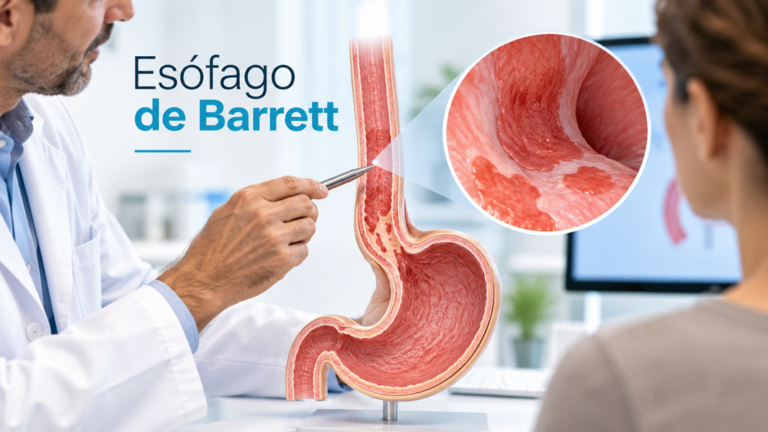
The Barrett's oesophagus It is an alteration of the inner lining of the esophagus that is usually associated with gastroesophageal reflux disease. It occurs when the cells that cover the lower part of the esophagus are replaced by other cells of different characteristics in response to prolonged exposure to the contents of the stomach.
Receiving this diagnosis can be worrying, especially for those who have experienced it before. relationship with esophageal cancer. However, most people with Barrett's esophagus do not develop cancer. The important thing is to know the characteristics of the disorder, identify whether there are any risk cellular changes, and establish proper monitoring.
In this guide we explain What is Barrett's esophagus, How it is diagnosed, how often revisions are recommended, and what endoscopic treatments can be used when lesions requiring intervention appear.
What is the Barrett esophagus?
The esophagus is the tube that transports food from the mouth to the stomach. Its inner wall is covered with a mucous membrane designed to facilitate the passage of food.
In the Barrett's esophagus, Part of this lining changes and acquires characteristics similar to those of the intestinal mucosa. This transformation, called intestinal metaplasia, usually occurs in the area closest to the stomach.
It is considered a pre-cancerous condition, Because in certain patients, cellular changes can occur that increase the risk of developing esophageal adenocarcinoma.
However, having Barrett's esophagus does not mean having cancer or that it will necessarily develop.
What are the symptoms?
- Burning or acid reflux: Burning sensation that rises from the stomach towards the chest.
- Regurgitation Return of stomach contents to the esophagus or throat.
- Discomfort in the upper abdomen: They can appear especially after meals.
- Nighttime reflux sensation: The symptoms may worsen when you lie down.
- Difficulty swallowing It can appear when other associated abnormalities are present, such as a narrowing of the esophagus.
- Pain or discomfort when swallowing: requires evaluation to identify its cause.
- Chronic illness: Persistent cough, especially at night, which may be related to gastroesophageal reflux.
- Hoarseness or changes in the voice: irritation of the throat that can cause voice changes, especially when waking up.
When to see a doctor
- Frequent or long-term reflux: especially when it is maintained for years.
- Progressive difficulty in swallowing: It may indicate a disorder that needs study.
- Weight loss without apparent cause: requires the elimination of relevant digestive diseases.
- Vomiting with blood or black stools: They are signs of possible digestive bleeding and require urgent attention.
- Previous diagnosis of Barrett's esophagus: It is important to maintain the indicated check-ups, even if no symptoms are present.
Causes
The Barrett's oesophagus It is closely related to prolonged exposure of the esophageal mucosa to stomach contents, mainly in people with gastroesophageal reflux disease. Among the mechanisms related to its occurrence are:
- Prolonged exposure to gastroesophageal reflux: Frequent contact of the acidic contents of the stomach with the esophagus can cause changes in its inner lining.
- Changes in the barrier between the stomach and the esophagus: When the lower esophageal sphincter does not function properly, it facilitates the ascent of the gastric contents towards the esophagus.
- Presence of hiatal hernia: It can promote gastroesophageal reflux by altering the mechanisms that normally prevent the return of stomach contents.
- Individual predisposition and family history: Certain genetic characteristics and having family members with Barrett's esophagus can increase the likelihood of developing this disorder.
- Abdominal obesity: Excess fat in the abdominal area can increase pressure on the stomach, favoring gastroesophageal reflux and exposing the esophageal mucosa to gastric contents.
- Alterations in the natural cleansing of the esophagus: When the esophagus does not properly remove the contents that rise from the stomach, the mucosa can remain exposed to acid and other components of reflux for longer periods of time.
Risk factors
There are various factors that can increase the likelihood of developing Barrett's esophagus, especially those related to gastroesophageal reflux and certain personal characteristics.
- Chronic gastroesophageal reflux: Frequent and prolonged exposure to the contents of the stomach can favor changes in the lining of the esophagus.
- Age over 50 years: Barrett's esophagus is most often diagnosed in middle-aged and older people.
- Male sex: Men are more likely to develop this disorder compared to women.
- Abdominal obesity: The accumulation of fat in the abdomen can favor reflux and is associated with an increased risk of Barrett's esophagus.
- Smoking Smoking is associated with an increased risk of developing Barrett's esophagus and may favor the progression of cellular abnormalities.
- Family history: Having first-degree relatives with Barrett's esophagus or esophageal adenocarcinoma increases the likelihood of developing this condition.
Complications
The main complication of Barrett's esophagus is the possibility that it will develop. progressive cellular alterations, known as dysplasia.
In a small proportion of patients, these changes may evolve into esophageal adenocarcinoma.
The risk is not equal in all people. It depends, among other things, on the extent of the Barrett's segment, the presence and the degree of dysplasia y certain individual characteristics.
Complications related to reflux can also coexist, such as inflammation of the esophagus or narrowing that makes swallowing difficult.
For this reason, the monitoring is not limited to controlling acidity, but seeks to identify possible changes in the mucosa before they progress into more advanced lesions.
Diagnosis
The Diagnosis of Barrett's esophagus It is performed through a gastroscopy, an examination that allows the inside of the esophagus to be directly observed and small samples of tissue to be obtained for analysis.
During the examination, the specialist assesses the extent of the altered mucosa and checks for any abnormalities. areas that require more detailed study.
Treatment
The Treatment of Barrett's esophagus It depends on the presence of dysplasia and the risk of progression.
In patients without dysplasia, it is generally recommended control gastroesophageal reflux y maintain an endoscopic surveillance program.
When certain cellular alterations occur, it may be necessary to resort to Advanced endoscopic treatments.
Forecast
The Prediction of Barrett's esophagus It is usually favorable when there is no dysplasia and appropriate follow-up is maintained.
Most patients do not develop esophageal cancer, although the risk increases when cellular abnormalities of a higher degree appear.
The Early detection of dysplasia It allows endoscopic treatments to be evaluated before the disease progresses.
After a Successful endoscopic treatment, It is still necessary to maintain controls, as recurrences or new alterations may appear over time.
Therefore, the prognosis depends both on the initial characteristics of the Barrett's esophagus and on the patient's age. Response to treatment y of the compliance with the recommended revisions.
Prevention
There is no measure that guarantees preventing the development of Barrett's esophagus, but certain habits can help control reflux and reduce some risk factors.
Among the main recommendations are:
- Maintaining a healthy weight: especially when there is excess abdominal fat.
- Avoid tobacco: Smoking is associated with an increased risk of esophageal disorders.
- Controlling gastroesophageal reflux: following the treatment indicated by the specialist.
- Avoid lying down immediately after eating: especially when there are nocturnal symptoms.
- Identifying foods that worsen symptoms: without the need to impose general restrictions unless they cause inconvenience.
- Elevate the head of the bedIt may be useful in patients with nocturnal reflux.
- Maintaining medical check-ups: especially when a confirmed diagnosis of Barrett's esophagus already exists.
These measures can improve reflux control, but they do not replace endoscopic monitoring.
Which specialists treat her?
Preguntas frecuentes
No. Most people with Barrett’s esophagus do not develop esophageal cancer. However, there is a risk of progression, which makes it advisable to establish individualized follow-up, especially when dysplasia is detected.
It depends on the extent of the affected segment and the results of the biopsies. In patients without dysplasia, revisions can be performed every three or five years, while the presence of cellular abnormalities may require more frequent monitoring or treatment.
In certain situations, yes. Techniques such as radiofrequency ablation allow the removal of the altered tissue, while endoscopic resection is used to remove selected visible lesions. These treatments are indicated primarily when dysplasia or other risk lesions are present.
Treatment with proton pump inhibitors is usually recommended in patients with Barrett's esophagus, but the dose and duration should be individualized based on the clinical situation and the specialist's recommendations. Medication should not be modified or discontinued without medical evaluation.