Receiving a diagnosis of an injury in the rectum can be worrying, especially when the possibility of surgical intervention is raised. However, not all injuries require surgery. Thanks to advances in digestive endoscopy, There are less invasive alternatives, such as Endoscopic submucosal dissection (ESD), These allow certain cases to be treated without the need for a conventional operation.
But when is this technique possible to use? What advantages does it offer and in what situations does surgery remain necessary? Knowing the differences helps to understand the available options and the importance of specialized evaluation.
What is endoscopic submucosal dissection (DSE)?
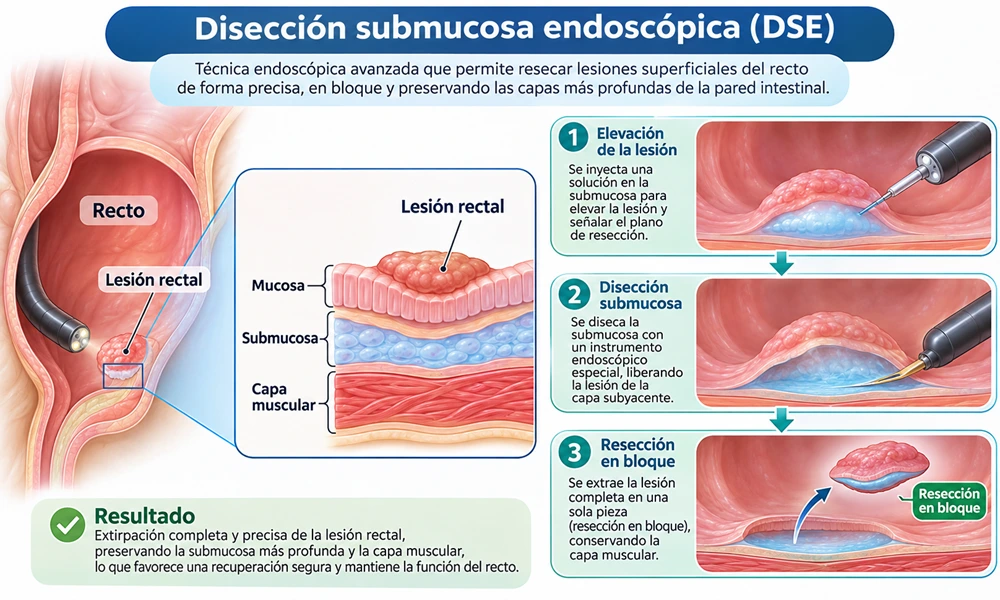
The Endoscopic submucosal dissection It is an advanced technique that allows the removal of certain lesions in the digestive tract using an endoscope, without the need for external incisions.
In the case of the rectal injuries, The specialist inserts the endoscope through the anus and uses specific instruments to carefully separate the lesion from the underlying layers of tissue.
One of its main features is that it allows one to perform a block resection, That is, extracting the injury in one piece.
This makes it easier to analyze it later in pathological anatomy, which is fundamental to determine whether the removal was complete and whether any additional treatment is necessary.
The DSE can be quite useful for treating superficial injuries that, due to their size, characteristics, or location, are difficult to remove using conventional endoscopic techniques.
When can an anal injury be treated with DSE?
Not all rectal injuries have the same characteristics or require the same treatment. The choice depends primarily on their size, depth, appearance, and possible tumorous nature.
The DSE rectal It can be considered in certain situations:
Large or complex rectal polyps: when its size or shape makes conventional techniques for removal difficult.
Flat or depressed injuries: They may need a more precise resection to ensure their removal and study.
Injuries with suspected superficial invasion: when the assessment indicates that they could be limited to the outermost layers.
Injuries with previous scars: especially if there have been previous attempts at removal that make treatment difficult.
Certain precancerous rectal lesions or very early cancers: provided that they meet the medical criteria for endoscopic treatment.
It is important to note that The size of an injury does not in itself determine the need for surgery.. One large injury may be superficial, while another smaller injury may present characteristics that require surgical intervention.
Therefore, each case requires an individualized evaluation.
DSE vs. surgery: What are the main differences?
Although both options seek to treat the injury, there are important differences in the way the procedure is performed and its possible consequences.
Advantages of DSE in selected rectal injuries
When indicated, the Endoscopic submucosal dissection It can offer several benefits:
Without external incisions: The treatment is performed using endoscopy.
It allows certain injuries to be treated preserving the organ and avoiding, in selected cases, surgical resection.
Precise resection: It facilitates the removal of the complete lesion and the analysis of its margins.
Potentially faster recovery: It can reduce the aggressiveness of the procedure compared to major surgery.
Lower anatomical impact: It prevents certain consequences associated with surgical rectosigmoidectomy.
However, being less invasive does not mean that it is risk-free. Complications such as bleeding or perforation can occur, so it should be performed by professionals with experience in the field. Advanced therapeutic endoscopy.
When is surgery still necessary?
Surgery remains a fundamental option when the characteristics of the injury make endoscopic treatment insufficient.
This can happen when there is:
Deep invasion of the rectal wall.
Suspicion or presence of ganglion damage.
A high risk of residual disease after endoscopic removal.
Unfavorable histological characteristics that suggest additional treatment.
Inability to perform an adequate and safe endoscopic resection.
In these cases, surgery can be used to treat both the injury and the regional lymph nodes when necessary.
The decision should be based on the results of the tests and, especially in the case of suspected invasive cancer, on a multidisciplinary assessment.
How is it determined which treatment is most appropriate?
Before deciding between DSE or rectal surgery, It is essential to study the characteristics of the injury.
To determine the most appropriate treatment, the specialist may perform the following assessments:
Review of the colonoscopy: It allows you to know the size, location and appearance of the lesion.
Detailed endoscopic evaluation: using advanced imaging techniques to identify possible signs of invasion.
Additional tests: When indicated, they can help assess the depth and extent of the disease.
Patient assessment: taking into account medical history, general condition and risks of the procedure.
Choosing the treatment: The specialist determines whether the injury can be treated with endoscopy or whether surgery is needed.
In addition, after performing a DSE, the analysis of the removed tissue is decisive. Although it is initially considered a complete treatment, the results may indicate the need for additional surgery.
What happens after a rectal DSE?
Recovery depends on the Characteristics of the injury and of the complexity of the procedure.
In some cases, discharge is possible after a period of observation, while other patients may require hospital monitoring.
After the intervention, the medical team provides instructions regarding nutrition, physical activity, medication, and warning signs.
It is also fundamental the Endoscopic follow-up, which allows checking the evolution of the treated area and detecting possible new lesions.
The periodicity of the revisions is set individually, according to the anatomical and pathological results and the history of each patient.
GASTEA: specialized evaluation of rectal injuries using advanced endoscopy
The Endoscopic submucosal dissection It has expanded the possibilities of treatment for certain diseases. rectal injuries, offering an alternative to surgery in carefully selected patients.
However, the key is not always to choose the least invasive technique, but to identify the treatment that offers the highest guarantees of safety and effectiveness for each situation.
And GASTEIZ, We have specialists in Advanced digestive endoscopy that they value the characteristics of each injury to determine the most appropriate treatment options.
Have you been diagnosed with an anal injury and want to know your options?